
Why we believe in insulation
Our perspective on Europe's renovation bottleneck, and why we invested in VARM


When people picture climate technology, they tend to imagine something new: a direct air capture plant, a next-generation battery, a fusion reactor. They rarely picture a crew making an old house cheaper to keep at room temperature, even though it is one of the most important climate measures we have for Europe's building stock. That measure is insulation, easy to overlook but also one of the cheapest and most immediately available levers Europe has.
Buildings are responsible for roughly 40 % of the EU's final energy consumption and 36 % of its energy-related greenhouse gas emissions12. That makes the built environment one of the biggest barriers between Europe and its 2050 climate-neutrality goal. Around 101 million of the EU’s buildings are residential, and roughly three quarters of them are energy inefficient, which is why the European Commission wants 35 million building units renovated by 2030 and the rest to follow by mid-century345. Most of that inefficiency comes down to the building envelope: the walls, roof and windows through which heat escapes in winter and enters during summer. The technology is mature and the demand isn’t going away. What has been missing is a way to deliver it at scale.
At Aurum Impact, we’ve spent the last while digging into the insulation sector, and we’re convinced insulation deserves far more attention and capital than it gets. In this piece, we want to share our perspective by looking at:
Why insulation is an urgent, and underrated, impact challenge
Why insulation comes first in decarbonizing a home
What’s holding the market back
Why now is the time to build
Where the market is heading, and why we backed VARM
But before we dive in, a quick word on where insulation actually does its work - the thermal envelope.
The thermal envelope
A building gains and loses heat where its envelope - meaning the walls, roof, windows, floor and the gaps in between - meets the climate outside. The walls are usually among the largest source of leakage, with peer-reviewed analysis of uninsulated buildings attributing roughly 34 % of total heat loss to the external walls alone, while the roof, windows, ventilation and floor account for the rest6. That makes the external walls one of the first things worth tackling in any insulation project.
1. Why insulation is an urgent, and underrated, impact challenge
The scale of the problem is defined less by new construction than by the buildings we already have. Roughly 75 % of the EU's building stock is considered energy inefficient, and between 85 % and 95 % of today's buildings are expected to still be in use in 2050789. Leaving this unfixed costs us in two ways:
A climate problem. Buildings that last 50 years or more and are poorly insulated don’t just waste energy just once. They keep on wasting energy, and thus contributing to GHG emissions, for every running year. In advanced economies, space and water heating alone sum to around 70 % of residential energy use10. Heating our buildings produces around 4,000 million tonnes of CO₂ every year, roughly 10 % of all energy-related emissions worldwide11. That makes insulation one of the biggest factors in reducing both a home's emissions and its energy bills. Insulate it well, and the emissions avoided add up year after year, for the rest of the building's life.
A social problem. Poor thermal performance is also a question of equity. In 2022, more than 41 million Europeans, around 9 % of the population, could not keep their homes adequately warm, a figure that rose further in 202312. Poorly insulated homes leave the most vulnerable households exposed to volatile energy prices, higher bills, and the health risks that come with living in cold, damp, and moldy spaces13. Plenty of measures cut emissions and bills together, from heat pumps to solar, but insulation is usually the cheapest place to start and the one that makes all the other interventions work better.
Takeaway: Much of Europe’s building stock is poorly insulated, which means it wastes energy and adds GHG emissions every year of use. The same problem hits people's wallets. Poorly insulated homes are expensive to heat, and more than 40 million Europeans already cannot afford to keep warm.
2. Why insulation comes first in decarbonizing a home
There are plenty of ways to cut a home’s emissions, such as swapping a gas or oil boiler for a heat pump, installing solar panels, adding a battery, improving ventilation, or insulating the building itself. Insulation is the logical place to start for two reasons:
It delivers some of the deepest emissions cuts available. Insulating a building is consistently one of the cheapest and quickest ways to cut its energy use. Less heat escaping means less energy needed in the first place. Peer-reviewed studies comparing insulated and uninsulated homes find that good insulation can cut heating season CO₂ emissions by roughly 66 % to 76 %, and cooling season emissions by 46 % to 69 %, depending on the climate and the material used14.
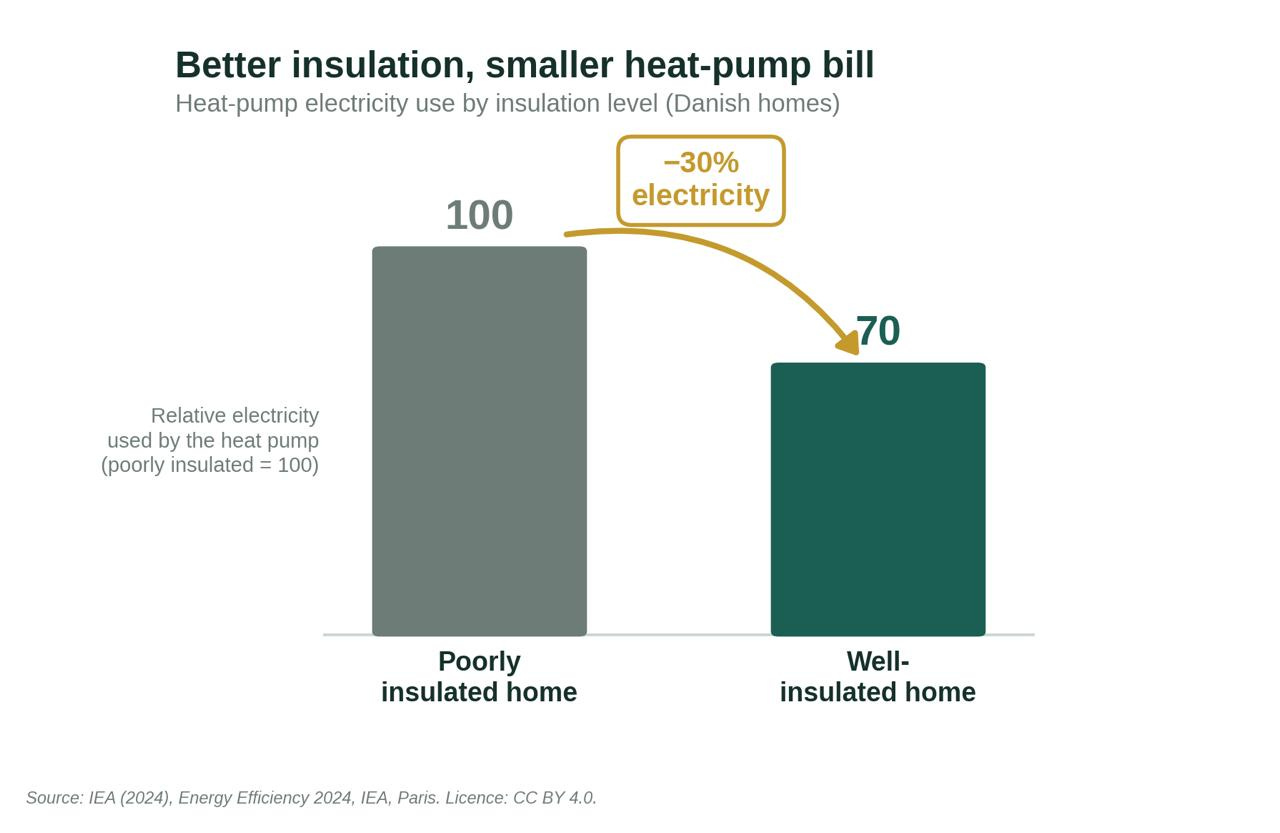
It is a prerequisite for clean heating. Heat pumps depend on a building's envelope to work well. The International Energy Agency (IEA) is explicit that in poorly insulated homes the financial and efficiency case for a heat pump weakens15. For example, a recent study of Danish homes revealed that a well-insulated home lets a smaller, cheaper heat pump run at peak efficiency (see Figure 1).
Takeaway: Proper insulation delivers significant emission cuts, and makes heat pumps and the wider electrification of heating economically viable and efficient.
3. What's holding the market back
If the case for insulation is this clear, why is so little of it happening? Europe renovates its building stock at a rate of <1 % per year, far below the pace required to hit its climate targets, which broadly calls for a rate of at least 2%16. The main bottleneck is delivery:
The insulation market is fragmented and opaque. Insulation work is done by Europe's building trade, which is made up almost entirely of tiny firms: 99 % of the companies in the sector are small or medium-sized, most of them micro businesses17. For a homeowner, that means there is no obvious place to turn to: Insulation is sold and installed by thousands of small local providers, with little standardization and no easy way to get a quote, compare options, or tell whether the work will be any good. According to McKinsey, it is a market so opaque that even experienced buyers struggle to find their way around1819.
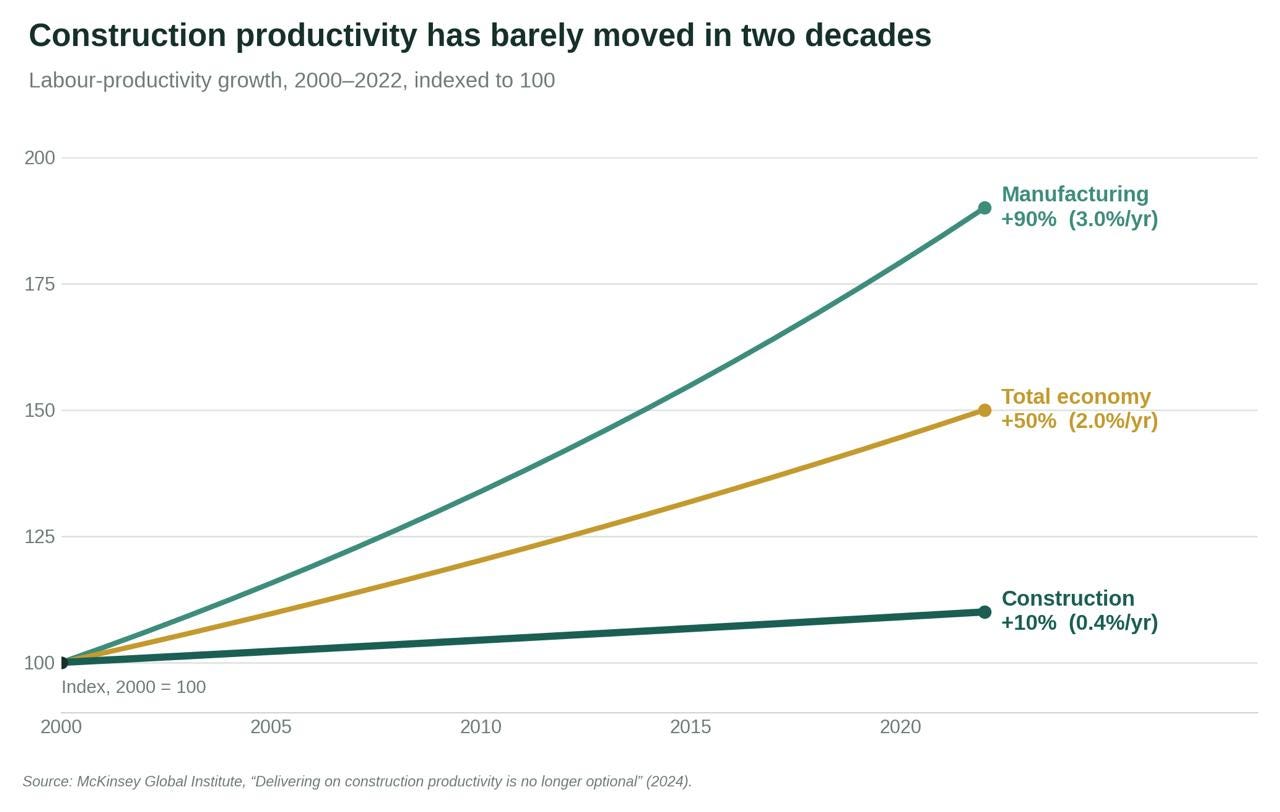
Skilled workers are scarce and capacity is tied up in admin tasks. This is the heart of the problem and it has two compounding parts. First, skilled tradespeople are scarce, with construction crafts ranking among Europe’s most shortage-affected occupations2021. Second, the few who are available spend much of their time on everything but the craft itself: chasing leads, writing quotes, sourcing and ordering materials, scheduling jobs, filing subsidy paperwork, and handling invoicing. A small craft firm has no back office to absorb any of this, so its scarcest and most expensive resource, skilled labor, gets burned on admin instead of installation. It shows in the numbers: Construction is one of the few sectors where productivity has barely moved in decades, growing only about 0.4 % per year since 2000 while the total economy’s productivity increased by 2% per year (see Figure 2)2223.
Takeaway: The insulation market is held back by a fragmented and opaque supply side that buyers struggle to navigate. In addition, a shortage of skilled workers and heavy admin work slow everything down.
4. Why now is the time to build
So why might the next decade look different from the last? Because a few things are happening at the same time:
Tightening regulation. The Energy Performance of Buildings Directive (EPBD, EU/2024/1275) sets the EU on a path to a fully decarbonized building stock by 2050, with binding interim milestones. These include a required reduction in the average primary energy use of the residential stock of at least 16 % by 2030 and 20 to 22 % by 203524. The directive explicitly puts the building envelope at the center of how those targets are to be met. In Germany, for example, insulating the building envelope is subsidized at up to 20 % of the cost, while also mandating minimum insulation standards whenever a facade or roof is substantially renovated25.
Structurally higher energy prices. Household electricity prices in the EU rose steadily after 2021 and gas prices were almost twice as high in 2023 as before the crisis2627. When bills are increasing every month, reducing the amount of energy a home needs in the first place becomes the smartest action a homeowner can take.
The heat pump rollout. As Europe electrifies heating, insulation becomes even more relevant. Every home preparing for a heat pump is a home that first needs its envelope addressed.
The back office goes digital. The pricing, scheduling, procurement and documentation that used to swallow an installer's day can increasingly be automated, often with AI, letting standardized, digitally-steered delivery models scale.
Takeaway: Regulation, energy prices, the heat pump transition and a structural shift toward industrialized delivery are all pushing insulation from a nice-to-have to a necessity.
5. Where the market is heading, and why we backed VARM
Project these trends forward and the end state is fairly clear. Retrofitting shifts from slow, fragmented craftsmanship to a standardized service that is fast, predictable and quality-checked. Planning, scheduling and quality control are digitally guided rather than dependent on craftspeople’s scarce time. Insulation of the envelope comes first, lowering heat demand so that every downstream technology, heat pumps above all, becomes cheaper and more effective.
The hard part is not the technology, but the execution. Building an organisation that can deliver insulation at scale, reliably and fast. That is where VARM comes in.
We recently invested as part of VARM's €17.5M Series A, led by ABN Amro Sustainable Impact Fund alongside GET Fund and existing investors Pale Blue Dot, Emerge and noa. VARM is the vertically integrated player this market has been missing: Rather than leaving planning, sourcing, scheduling, installation, quality control and billing to a chain of separate small firms, it owns the whole process end to end and runs it on its own software layer. It turns a fragmented craft into a repeatable industrial process, taking over the pricing, planning, routing, procurement and documentation that normally eat up an installer's day, so the people on site can focus on the work itself. Every job runs through the same system with built-in quality checks, which is how VARM reaches standardized, verifiable quality at a scale individual craft firms cannot. Beyond that, VARM trains new installers through an in-house academy.
VARM is starting with straightforward and repeatable insulation work on walls, the biggest lever, and is systematically broadening its scope to other parts of the thermal envelope after that.
In the end, we are backing people. We could not be more excited to support Christian and Sebastian, who bring the rare mix of operational rigor and ambition that insulating Europe's homes has long been waiting for. The need is huge, the timing is right, and we are proud to be on the journey with them.
We'd love to hear your thoughts. If you're a founder working on the industrialization of renovation, or an investor thinking about this space, reach out to birgit.handl@aurum-impact.de
Aurum Impact is an impact investing firm backed by the Goldbeck family. We empower systemic change by investing in founders and funds with a clear commitment to solving today’s most pressing social and environmental challenges. Our portfolio includes impact companies such as Cyclize, Paebbl, and Voltfang as well as impact funds including Planet A Ventures, Revent, Counteract, and more.
https://commission.europa.eu/news-and-media/news/focus-energy-efficiency-buildings-2020-02-17_en
https://www.consilium.europa.eu/en/infographics/fit-for-55-making-buildings-in-the-eu-greener/
https://energy.ec.europa.eu/topics/energy-efficiency/energy-performance-buildings/eu-building-stock-observatory_en
https://commission.europa.eu/news-and-media/news/focus-energy-efficiency-buildings-2020-02-17_en
https://eur-lex.europa.eu/legal-content/EN/TXT/HTML/?uri=CELEX:52020DC0662
https://www.sciencedirect.com/science/article/abs/pii/S0960148125007207
https://commission.europa.eu/news-and-media/news/focus-energy-efficiency-buildings-2020-02-17_en
https://eur-lex.europa.eu/legal-content/EN/TXT/HTML/?uri=CELEX:52020DC0662
https://www.eea.europa.eu/en/topics/in-depth/buildings-and-construction
https://www.iea.org/reports/energy-efficiency-2025/building
https://www.iea.org/energy-system/buildings/heating
https://www.bpie.eu/publication/analysis-of-eu-and-national-level-policies-related-to-renovation-and-alleviating-energy-poverty/
https://www.who.int/publications/i/item/9789241550376
https://link.springer.com/article/10.1007/s10098-021-02233-6
https://www.iea.org/reports/energy-efficiency-2024/does-a-heat-pump-work-in-a-house-with-poor-insulation
https://energy.ec.europa.eu/topics/energy-efficiency/energy-performance-buildings/energy-performance-buildings-directive/energy-renovation-buildings_en
https://energy.ec.europa.eu/topics/energy-efficiency/energy-performance-buildings/energy-performance-buildings-directive/energy-renovation-buildings_en
https://www.mckinsey.com/capabilities/operations/our-insights/delivering-on-construction-productivity-is-no-longer-optional
https://www.mckinsey.com/capabilities/operations/our-insights/reinventing-construction-through-a-productivity-revolution
https://eures.europa.eu/living-and-working/labour-shortages-and-surpluses-europe_en
https://eur-lex.europa.eu/legal-content/EN/TXT/HTML/?uri=CELEX:52020DC0662
https://www.mckinsey.com/capabilities/operations/our-insights/reinventing-construction-through-a-productivity-revolution
https://www.mckinsey.com/capabilities/operations/our-insights/delivering-on-construction-productivity-is-no-longer-optional
https://eur-lex.europa.eu/eli/dir/2024/1275/oj
https://www.bafa.de/DE/Energie/Effiziente_Gebaeude/Sanierung_Wohngebaeude/Gebaeudehuelle/gebaeudehuelle_node.html
https://ec.europa.eu/eurostat/statistics-explained/index.php?title=Electricity_price_statistics
https://energy.ec.europa.eu/data-and-analysis/energy-prices-and-costs-europe_en